30.10.2026 | Publication
Breaking the Cycle: New report on neurodivergent children in temporary accommodation
Living in temporary accommodation is one of the clearest signs of child poverty in the UK today. Between 25,000 and 120,700 neurodivergent children may be living in temporary accommodation across the UK. And in high-pressure housing areas such as London, families can remain in temporary accommodation for years.
Our new report, ‘Breaking the Cycle: Opportunities for Systemic Intervention for Neurodivergent Children in Temporary Accommodation’, looks at the reality and impact of this instability on neurodivergent children and their families, and sets out how local services can work together to give them the stable foundation every child needs. It explores experience – from overcrowded rooms, disrupted sleep, frequent moves and lack of play or green space – in depth in order to inform solutions.
Five pillars for change
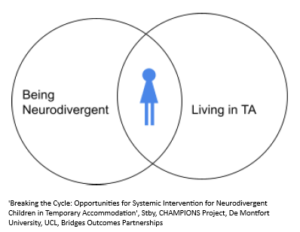
Neurodivergent children in temporary accommodation are among the most exposed to the combined harms of poverty, housing instability, unmet SEND needs and fragmented services, and risk remaining invisible in the very policies designed to help them. This report identifies five connected areas where action could make a lasting difference:
- Wrap-around support that brings housing, education, health and family services together around the child.
- More suitable temporary accommodation that better meets children’s sensory and developmental needs.
- Prioritised access to health and care, including earlier identification and intervention.
- Continuity in education when families have to move.
- Empowering parents and carers through employment, welfare and work support.
Together, these offer a framework for moving from reactive crisis management towards support that is preventative, joined-up and centred around the child.
Carried out by design research agency Stby and commissioned by Bridges Outcomes Partnerships, the research focuses on children aged 7 to 11 living in London, and their families. It was written by Dr Qin Han and Riya Gokharu, with contributions from Professor Monica Lakhanpaul (University College London) and Professor Nadia Svirydzenka (De Montfort University), and is built on the lived experiences of families, alongside insights from the caseworkers, teachers and healthcare professionals who support them every day.
Read the report here.
Related news
View all-
13.08.2025 | Publication
Understanding person-centred service reforms in housing support: A new report from Government Outcomes Lab
-

13.12.2024 | Publication
‘Shifting Gears’: A new report from BOP & GSG Impact
-

29.05.2024 | Publication
‘Liberated Public Services’: BOP expertise informs galvanising Demos Taskforce paper
-
13.08.2025 | Publication
Understanding person-centred service reforms in housing support: A new report from Government Outcomes Lab
-
13.12.2024 | Publication
‘Shifting Gears’: A new report from BOP & GSG Impact
-
29.05.2024 | Publication
‘Liberated Public Services’: BOP expertise informs galvanising Demos Taskforce paper