Partnering with Local & Health Commissioners
Outcomes contracts are a different way of procuring, funding and delivering local services – more efficient, more effective.
We work alongside commissioners in a variety of ways, including:
- Co-creating new services according to commissioner goals and priorities
- Test, learn and adapting throughout the programme lifecycle
- Strengthening existing services (operations, upskilling, data & learning)
- Data-led project management to increase accountability and enable greater impact
- Identifying, supporting and managing local VCSE delivery partners to do what they do best
We cover the upfront costs of programme delivery via pooled, flexible social investment – at no risk to the commissioner. The commissioner only pays for outcomes when they are achieved and evidenced.
Want to talk more about how outcomes partnerships can support your policy priorities? We’d love to hear from you.
How we use data
Data is a key enabler in our work. We invest in digital infrastructure and other areas to support VCSEs and partners to measure, track, analyse and adapt delivery in real time for best results.


How we work with VCSEs & other delivery partners
We work closely with VCSEs and other delivery partners to support, manage, and develop teams. From monthly performance Board meetings to staff upskilling and creative problem-solving, we ensure teams are accountable and well-equipped to do what they do best.
FAQs
-
An ‘outcome’ (social or environmental) is the measurable, meaningful change (in lives, communities, or to the planet) we, in partnership, want to achieve.
From the outset, we work with commissioners and partners to understand their priorities and the real-world change they’re looking to create for individuals and communities. Together, we use these goals to define locally relevant outcomes upon which programme design, delivery and an overall contract are based.
During delivery, outcomes and the milestones towards them are tracked (according to mutually agreed frameworks) and independently verified. Example outcomes include:
- Unpaid carers sustaining a caring role for six months;
- Individuals with long-term health conditions reducing their primary care use over 12 months;
- Recently homeless (or at risk) individuals sustaining accommodation for six months.
-
Commissioners only pay for successful outcomes achieved (and any pre-agreed key milestones).
Because we focus on achieving meaningful, long-term outcomes, this approach means commissioner payment is only made when measurable impact is achieved and evidenced.
A payment rate for each defined outcome is agreed with commissioners in advance. Some outcomes may be worth more than others due to considerations like higher overall impact or contribution to cost avoidance in the short, medium, or long term.
In order for VCSE delivery partners to deliver the agreed service, BOP pools together social investment to fund delivery activity and achievement of outcomes upfront. This working capital covers all programme costs and outgoings – shifting risk and upfront costs from delivery organisations and commissioners to social investors.
When outcomes are achieved and fully audited by a third party (typically commissioners themselves), the commissioner pays the value of these.
-
Most traditional public services contracts issue a ‘service specification’ which defines the activities to be carried out, and an ‘inputs budget’ which defines the resources to be used. Commissioners pay upfront for these inputs and try to measure the results (outcomes achieved) after the service has been delivered.
This works well for single, easily diagnosed problems, but it evidently fails where people are facing multi-faceted, complex problems.
An outcomes contract works the opposite way around: it defines the desired outcomes and their value first – this value is paid for by commissioners only once these outcomes have been achieved and verified.
Delivery teams – along with BOP’s expertise, guidance and the flexible funding it pools together – are free to design their own service specification and adjust resources, spending, and activities on an ongoing basis, as they learn what approaches work best in their unique context. (There may however be certain specific requirements built into the contract, for example to ensure Care Act compliance.)
What does this mean in practice? Teams can decide to buy in more resources or to recruit more staff if demand rises; if they discover that a particular resource or area of the project is not working well, they can divert the money towards areas where it has the most benefit.
Teams are also encouraged and focused on trying new approaches/creative solutions that haven’t been tried before without financial risk. And for commissioners, delaying payment until positive outcomes are achieved facilitates the double-running of acute and preventative services.
-
This is exactly the beauty of outcomes contracts and outcomes partnerships.
This approach is by nature highly flexible, local, and relationship-based (rather than transactional). We work in partnership with commissioners to understand their specific priorities and what outcomes they are looking to achieve. These could include:
- Preventing individuals entering longer term care
- Supporting individuals to maintain their carer role
- Supporting individuals to find and sustain a home
- Increasing employment among a certain cohort
- Improving service users’ health and wellbeing
We bring together local organisations – which would ordinarily compete for funding – around a shared goal: that of improving the lives of individuals using local services. We then support and develop these partnerships to make this goal a reality – building capacity locally at the same time.
By focusing on real-world, shared outcomes, this approach better addresses multi-faceted challenges and helps break through public service silos.
-
Procuring outcomes contracts is different to the standard Local Authority tendering process, and is closely aligned with the Government’s new Procurement Act (February 2025) – which has introduced a number of changes that support greater flexibility and partnering in public procurement processes (learn more here).
Traditional procurement usually involves the commissioning authority providing a set specification, for which delivery organisations are marked against set criteria.
Outcomes contracts are not tied to a prescribed specification (though certain elements will be mandatory). Instead, delivery organisations and consortia are able to allocate resources and adapt activity through a test and learn approach, according to what works for peoples’ unique circumstances. This means we carry out a detailed exploration process to help us to fully understand commissioner requirements and considerations.
Together, we agree on pricing for the outcomes in advance. We establish a contract cap, the maximum amount commissioners are happy to pay, which is paid incrementally according to how many outcomes are achieved during the programme (rather than as a fixed annual amount).
If outcomes achieved exceed targets, commissioners only pay up to the agreed contract cap. If the maximum number of outcomes are not achieved, the contract cap is not reached; you only pay for what has been achieved. This may mean more involvement from your finance teams and other stakeholders, due to the better value for money delivered.
-
We pool funding from social impact investors into dedicated social impact funds.
Using this funding, we provide project finance to VCSE and other delivery organisations we have partnered with, so they can deliver specified social and/or environmental outcomes (pre-agreed with commissioners). The funding is repaid by commissioners only once outcomes have been achieved and evidenced; this shifts risk and upfront costs from delivery organisations and commissioners to our investors. BOP is a not-for-profit social enterprise and manages these funds on a not-for-profit basis.
UK Cabinet Office seeded the first pooled social investment fund which supported outcomes partnerships. This report analyses the approach in detail.
-
Social impact investors intentionally pursue positive social outcomes and often prioritise long–term societal value – such as improving individual or community health and wellbeing, increasing access to education, or advancing equitable opportunities.
They focus on creating impact: evaluating performance using impact measurement frameworks, supporting initiatives that enable positive change in people’s lives or the planet.
UK Cabinet Office seeded the first pooled social investment fund which supported outcomes partnerships. This report analyses the approach in detail.
Our investors are primarily government institutions, and patient social investors such as benevolent funds, foundations, and pension funds.
-
If outcomes aren’t achieved, the commissioner doesn’t pay.
Because payment is tied to achieving outcomes, we use all the tools, teams, and creative thinking we have to ensure that a service delivers outcomes successfully.
The flexible nature of this approach means we can keep iterating to find the best ways to do this. This could mean anything from purchasing additional services, developing staff training offerings, or stopping activities with low impact and finding new creative solutions instead.
Alongside learnings from data analysis, we hold ongoing conversations with frontline staff and service users to learn what is really working on the ground, to identify key needs, and to tailor the service accordingly.
The benefit paying for outcomes has over flexible block grants, is that it doesn’t just enable innovation but goes further and actively incentivises it.
-
We agree on a contract cap, so the commissioner can be reassured that they will never have to pay more than this maximum figure over the lifetime of the programme (unless otherwise agreed). Any additional outcomes that are achieved above the contract cap are bonus positive impact for individuals and/or the community!
-
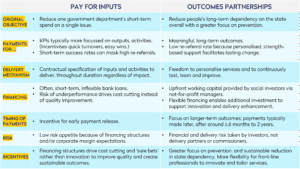
Outcomes contracts differ to traditional fee for service, or ‘pay for inputs’, contracts. See below for a comparison of key features and an example of what this might look like in practice for ‘The Sunshine Project’…
IN PRACTICE: The Sunshine Project provides support to unpaid carers in a county. The number of unpaid carers needing to access services rises unexpectedly, demand on the service is higher than expected.
How does The Sunshine Project respond?
+++
Pay for inputs –> There are no additional funds to recruit more staff; workload and wait times become unsustainable; staff morale and overall care quality reduces; Care Act obligations are not met.
Outcomes contract –> The unexpected rise is identified early via data analysis; necessary extra staff numbers are forecast; flexible funds are allocated to recruit new staff and cover demand, helping more carers.
+++
Pay for inputs –> Retrospective reporting identifies issues only during reporting period; accountability is poor; narrow reporting means emerging trends are not acted upon early.
Outcomes contracts –> Progress dashboards are live for frontline staff, managers and strategic leads; monthly delivery and strategic boards maintain collective accountability of all partners; reporting holistically helps identify root causes and emerging trends.
Want to speak to our team? Want to talk to local authorities who already commission outcomes contracts?
Contact us“Payment by outcomes has got to be the way forward. We don’t work with another service like the Single Homelessness Prevention Service. We get good results. We have referrals queuing up.”
Local Authority Representative, Single Homelessness Prevention Service (London)
Our Partners
We work with individuals, communities, Governments, foundations, corporates, delivery partners and social investors to co-develop and deliver innovative people powered partnerships and services. Our network of over 150 partners continues to grow; see below for a snapshot selection.
-
Street Child Sierra Leone
-

EducAid Sierra Leone
-

Government of Ghana
-

Ministry of Justice
-
Government of Sierra Leone
-

Lewisham
-

Northamptonshire County Council
-

Birmingham City Council
-
Foreign, Commonwealth & Development Office
-
Single Homeless Project
-

Cabinet Office
-
London Borough of Waltham Forest
-

Brent Council
-

NHS North East Lincolnshire
-

Great Yarmouth Borough Council
-

Ealing Council
-

Bristol City Council
-

NHS Newcastle Gateshead